> ## Documentation Index
> Fetch the complete documentation index at: https://docs.tavus.io/llms.txt
> Use this file to discover all available pages before exploring further.
# Phoenix-4 Image Requirements
> Photo rules for training a Phoenix-4 face from an image.
Use this path when you call [Create Face](/api-reference/faces/create-face) with **`model_name`: `phoenix-4`** and **`train_image_url`**. The image must be at a **publicly accessible URL** (for example a presigned S3 GET URL). You also [attach a voice](#voice).
See [Choose a Model and Training Path](/sections/faces/which-training-path) if you are still deciding. For Phoenix-4.5 photos, see [Phoenix-4.5 Image Requirements](/sections/faces/phoenix-45-image-requirements).
We recommend using the [PAL Maker](https://maker.tavus.io/dev/faces/create) to upload an image. It runs the same checks the API uses, with real-time validation before training.
Phoenix-4 faces are ready when training finishes, typically **3–4 hours**.
Image requirements
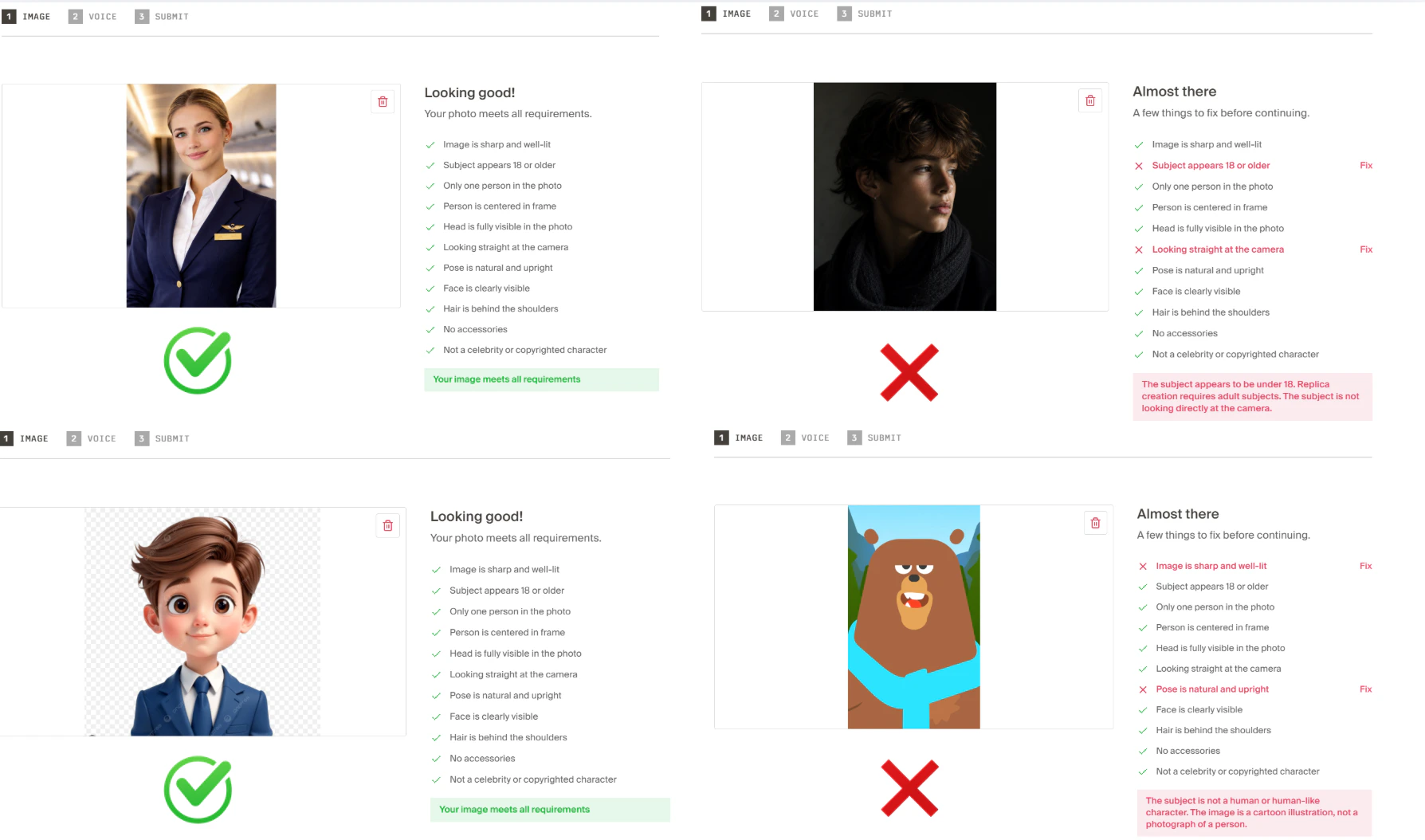
Phoenix-4 uses a stricter checker than Phoenix-4.5.
* **Formats:** JPG or PNG
* **Minimum resolution:** 512×512 pixels
* **Only one person** visible in the image
* **Subject is an adult** (18+)
* **Human-shaped subject:** realistic, cartoon, anime, and Pixar-style faces are all fine. Animals, mascots, and other non-human figures are not
* **Head fully in frame**, subject centered, looking straight at the camera
* **Upright, neutral pose** (not leaning, lying down, or mid-gesture)
* **Face not blocked** by hands, phones, masks, or heavy hair over the eyes and nose
* **Even lighting** with minimal shadows across the face
* **Not** a household-name public figure or an obvious copyrighted character
* **Head and shoulders** clearly visible
* **No glasses**, face-covering accessories, or over-ear headphones
* **Avoid visible jewelry** such as large earrings or necklaces
* **Keep hair behind the shoulders** and away from the face and neck (no tall hairstyles that stack high above the face)
* **Neck visible** (avoid turtlenecks, high collars, or hair covering the front of the neck)
* **Sleeves or wide straps** (strapless and spaghetti straps fail)
* **No dense beard** covering the neck or collar
Attach a voice
A photo has no audio, so nothing gets cloned the way it does on the video path. Send a voice on the same [Create Face](/api-reference/faces/create-face) request - a stock voice or one you train yourself. See [Voices for Image-Based Faces](/sections/faces/voices-for-image-based-faces).
AI Image Fixer
If your uploaded image doesn't fully meet these requirements, set **`auto_fix_training_image`** to `true` when calling [Create Face](/api-reference/faces/create-face). Tavus's AI Image Fixer adjusts the uploaded image to fit. Some policy failures (for example under-18 or copyrighted characters) cannot be auto-fixed.
```json theme={null}
{
"face_name": "my_image_replica",
"model_name": "phoenix-4",
"train_image_url": "https://example.com/headshot.png",
"auto_fix_training_image": true
}
```
## Consent, rights, and acceptable use
By using the image training API, you **affirm that you have the rights** to use the image you supply (for example likeness and publicity rights where applicable). Tavus may **reject** images that appear to depict unauthorized or impermissible subjects.